

There are eight basic elements necessary in specifying draperies and window coverings. They are Function and Design, Hardware and Mechanisms, Pockets and Stack Backs, Fullness, Linings, Installer Instructions, and Care and Maintenance. I will go into each area using two treatments to demonstrate each point, Roman Shades and The Snap Pleat Drapery.
Function & Design
Before deciding upon the style or type of treatment the Architect/Designer (A/D) must analyze what the needs of the window covering are. First and foremost is the selection of a treatment that meets design requirements without sacrificing practical day to day function. Remember that “Function dictates Form”.
The Roman Shade
The Roman Shade is both a functioning treatment as well as decorative. This treatment lives up to the phrase “Function dictates Form”. The constructed Roman Shade is very reliable as it easily moves up and down with dressing or fussing with the pleats. Once in the stacked position it gives a “valance” look. There are two types of Romans that fall under what I call constructed”. The Flat Roman with ribs and the Soft Fold Roman.
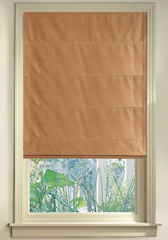
I also like to use the Soft Fold Roman when blackout lining is needed. The folds do a good job in covering the pinholes of light that pass through the lining. Additionally, the way we fabricate our Romans eliminates the visible tape from the street side. We use the lining as our support system instead of the unsightly tapes.
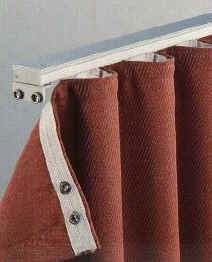
This treatment is one of the best functioning vertical stacking treatments. The Snap Pleat Drapery is created by a fabric tape with snaps sewn to the top edge of the drapery panel. When these snaps are attached to the carriers on the rod, this creates an “S” shape design. The fullness of this treatment is measured in the range of 80% – 100% – 120%. The weight of the fabric and the function will determine the appropriate fullness. A few of the attributes are:
- Soft flowing appearance
- Suitable for Commercial and Residential
- Panels can be pressed flat
- No Hooks or Pins needed
- Low track profile
- Smaller Stack-back then pleated drapery
- Looks good from front or back.
Hardware and Mechanisms
In the specifying of draperies and window coverings the hardware and the mechanisms are significant to its function. The hardware is typically the drapery rod or track and the mechanism refers to the lifting systems. I will explain both with the examples of the Roman Shades and the Snap Pleat Drapery.
The Roman Shade
When deciding upon the types of hardware and mechanism to specify, a few questions should be considered:
- Are the controls out of reach?
- Is the treatment too heavy to lift?
- Are there obstructions in the way?
- Is safety a concern?
Cord Locks
The basic lifting mechanism for Roman Shades is cords with a cord lock or a cleat. This is good to use for small and light shades as well as installations that require a shallow recess. A Roman Shade with a cord lock can be mounted on a 1 1/2″ headrail which is great for flush mounts in a tight area.
Clutch Lift
When a Roman Shade is large and/or heavy a clutch mechanism is required. The clutch lifting system distributes the weight across the width of the shade and the clutch wheel lightens the load. The chain the lifts and lowers the shade is a continuous length and can be secured.
Motorization
For conditions where access to the shade is difficult or heavy to lift, motorization is an excellent solution. There are many options in automating a window covering. From a simple “Plug n’ Play” to integration with an automation system, motorization offers many options. In the Roman Shade, the motors are inserted into the tube where the strings rollup on.
The Snap Pleat Drapery
The track for the Snap Pleat Drapery is very versatile and offers many options. The profile of the track is only 5/8″ high and can be wall mounted, ceiling mounted and recessed. The Snap Pleat track can be operated by a wand pull, traverse pull as well as motorized. The track can cover large areas and can be curved for special conditions.
Some hardware considerations are the master carriers. The choice is between a Butt Master and the Overlap Master. While the Butt Master offers a more pleasing esthetic when the panels meet, the Overlap Master provides better light blockage for room darkening treatments.
A nice feature of this system is the motorized track that simply needs to be plugged in to function. Hardwiring is also an option as well as integration with an automation system.
Pockets & Stack Backs
Careful consideration needs to be done when planning for drapery pockets and clearance for stack backs. Again, I will use the examples of Roman Shades and the Snap Pleat Drapery to demonstrate.
The Roman Shade
While it’s unlikely that a pocket would be created for a Roman Shade the stacking height does come into play. The Roman Shade does have a substantial stack. On a 60″ high shade, the stack could be about 10″-12″ depending on the style of roman and the fabric.
The Snap Pleat Drapery
The Snap Pleat Drapery has more options when specifying pockets and stack backs. The track needs a very shallow pocket since there are no pleats to hide. A 3″ high pocket is fine. The track can also be recessed into the ceiling into a 5/8″ recess.
The stack back is excellent with this system since the Snap Pleat Drapery has the smallest stacking of any drapery treatment. Charts are available to determine what the stack backs are according to the fullness of the drapery.
The next article will address Fullness, Linings, Installer Instructions, and Care and Maintenance.